Contents
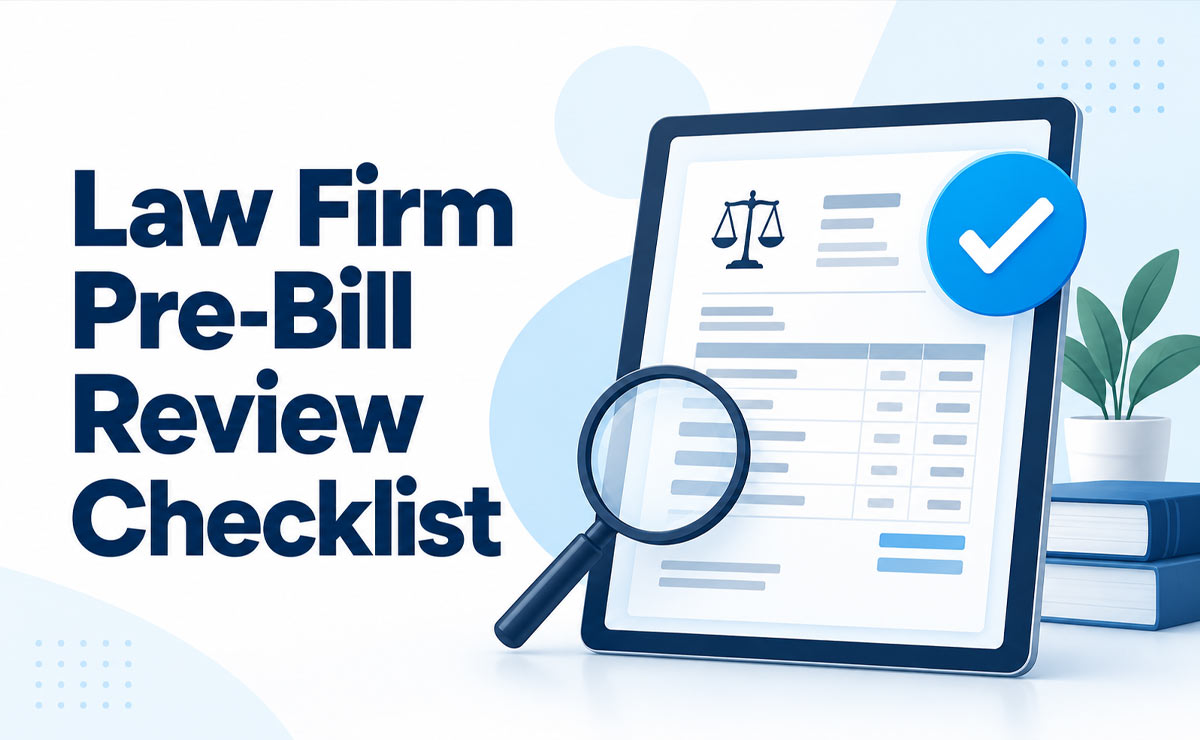
A client should not be the first person to spot a repeat entry, vague note, wrong rate, or odd charge. A law firm pre-bill review gives the firm one clear chance to fix those problems before a bill leaves the office.
The review should be more than a partner scanning the total and clicking approve. A sound process checks the source records and applies the fee terms. It logs each change and makes sure the final bill is clear. This guide gives firms a checklist, review flow, and key controls they can adapt to their needs.
What Is a Law Firm Pre-Bill Review?
A law firm pre-bill review is an internal quality-control step performed after the firm collects time and expense entries but before it issues the final invoice. The draft may be called a pre-bill, pro forma, worksheet, or draft bill. The label matters less than its status: it is not yet the client-facing invoice.
The review tests whether the draft is correct, complete, approved, clear, and in line with the fee agreement. It also gives the lead lawyer a chance to assess the bill as a whole. An entry may be correct but still need more detail, a new matter code, or a logged change.
Pre-Bill, Pro Forma, and Final Invoice
Firms do not always use these terms in the same way. Some treat “pre-bill” and “pro forma” as synonyms. Others use pro forma for an early worksheet and pre-bill for the final internal draft.
The firm should define each status in its billing rules. Staff must know which draft they can edit and who can approve it. They must also know what turns it into an official bill. A clear status helps stop staff from sending a draft by mistake.
When the Review Should Happen
The review should occur on a fixed billing schedule. A monthly cycle is common, but a firm may bill more often for high-volume work or use milestone billing for fixed-fee matters.
Set a deadline for time entry, draft creation, review notes, fixes, and bill release. This structure keeps the law firm pre-bill review from becoming an open task that delays every bill.
Why Law Firm Pre-Bill Review Matters
The invoice is both a financial record and a client communication. It shows what the firm did, who performed the work, what the client owes, and how the amount was calculated. Errors can create questions, delay payment, and weaken confidence in the firm’s records.
The ethical rules that apply depend on the firm’s jurisdiction. In the United States, the ABA’s Model Rule 1.5 states that fees and expenses must be reasonable and that the basis or rate should be communicated to the client. ABA Formal Opinion 93-379 also addresses accurate billing for professional time and other charges. These are model standards, not a substitute for the rules of the firm’s state, province, territory, or law society.
A steady law firm pre-bill review helps the firm apply its own terms before a dispute starts. It can also show process flaws. These may include late time entry, repeat coding errors, weak descriptions, or frequent write-downs in one type of matter.
Accuracy Protects More Than the Invoice Total
The reviewer should test the data behind the total. Common issues include work on the wrong matter, repeat costs, an old rate, or a missing discount. The trust balance may also conflict with the payment directions.
Correcting those items at the draft stage protects reporting as well as billing. If the source data remains wrong, the error may appear again in matter profitability, timekeeper performance, accounts receivable, or accounting reports.
Clear Bills Reduce Avoidable Questions
A client cannot evaluate an entry such as “attention to file” or “work on matter.” A better narrative identifies the task and its purpose without revealing privileged strategy or adding needless detail.
The goal is not to make every description long. It is to make each charge understandable in context. A clear bill supports a productive billing conversation if the client has a question.
Build the Rules Before Reviewing Draft Bills
A checklist cannot fix unclear billing rules. Before launching a law firm pre-bill review, define the checks that staff will use.
Start With the Engagement Terms
The fee agreement should be the first reference point. Reviewers need the agreed rates, fee type, cost rules, billing cycle, retainer terms, discounts, and payment plan. If the client has outside counsel guidelines, store those rules with the matter.
Do not rely on a partner’s memory for special terms. A note such as “client gets 10% off” is incomplete unless it states what the discount covers, when it applies, and who approved it.
Assign Clear Roles and Authority
Small firms can use a two-person flow. A billing staff member checks the details. The lead lawyer makes the judgment calls. A solo lawyer can split the work into two passes done at different times.
The rules should answer four questions:
- Who prepares the draft?
- Who checks time, expenses, and required fields?
- Who may approve write-downs, discounts, or no-charge entries?
- Who releases the final invoice?
The same person may hold more than one role, but the sequence should remain clear. The law firm pre-bill review needs an accountable final approver.
The 12-Point Law Firm Pre-Bill Review Checklist
Use the following checklist for each draft invoice. Adapt the details to the firm’s fee arrangements, local rules, and client requirements.
| Review point | What to verify | Common warning signs |
|---|---|---|
| 1. Client and matter | Correct client, matter number, billing contact, address, and invoice period | Similar names, closed matter, outdated contact |
| 2. Engagement terms | Correct fee model, rates, discounts, caps, billing frequency, and expense rules | Rate change not communicated, missing discount |
| 3. Time completeness | All work for the period is entered and submitted | Late entries, long gaps, unfinished timers |
| 4. Time accuracy | Dates, timekeepers, duration, matter, and task are correct | Duplicate entries, impossible overlaps, wrong matter |
| 5. Narratives | Each description is clear, specific, and suitable for the client | Vague text, internal shorthand, privileged detail |
| 6. Staffing | Work matches approved roles and staffing terms | Unapproved timekeeper, excessive attendance |
| 7. Billing codes | Required task, activity, phase, tax, or LEDES codes are present | Blank or inconsistent codes, rejected format |
| 8. Expenses | Costs are supported, categorized, authorized, and not duplicated | Missing receipt, markup, personal or overhead cost |
| 9. Adjustments | Write-downs, discounts, no-charge items, and credits are authorized and recorded | Silent deletion, unexplained override |
| 10. Trust activity | Any trust application or transfer matches earned fees and local requirements | Wrong client ledger, insufficient balance, premature transfer |
| 11. Totals and taxes | Subtotals, taxes, prior balances, payments, credits, and amount due reconcile | Manual total mismatch, stale balance |
| 12. Presentation and approval | Invoice is readable, branded correctly, addressed properly, and approved | Draft label remains, missing terms, no approval record |
Law Firm Pre-Bill Review: Check Time Entries at the Source
Do not limit the law firm pre-bill review checklist to the rendered invoice. When an entry looks unusual, open the source record. Confirm the matter, date, timekeeper, duration, activity, and billing status.
Look for repeat work and entries posted to the wrong file. Also check entries that describe the same event in different ways. If two people billed for one meeting, the reviewer should confirm that both entries are correct and allowed under the client’s terms.
Prompt recording makes this work easier. A connected legal time and expense tracking system can sort records by matter, staff member, date, and status. Software makes the records easier to see. The firm still needs clear review rules.
Apply Consistent Billing Narrative Guidelines
Good descriptions explain the work without turning the bill into a case memo. A useful entry names the action and subject. It can also state the goal or result when more context is needed.
For example, “Review correspondence” leaves the client guessing. “Review opposing counsel’s settlement offer and list response points” gives useful context. The reviewer should also remove firm shorthand and draft notes. The bill should not reveal private strategy that the client does not need to see there.
During the law firm pre-bill review, compare descriptions across the matter. Similar tasks should use the same terms. If the client requires task-based billing, confirm that the note and code describe the same work. The LEDES Oversight Committee offers tools for Uniform Task-Based Management System codes used in legal e-billing.
Check Expenses and Disbursements
Confirm that each cost belongs to the matter and meets the fee terms. Match high costs to receipts or vendor records. Check whether the client requires advance consent for travel, experts, filing fees, or other large costs.
ABA Formal Opinion 93-379 separates charges tied to a client matter from general office overhead. It also says billed charges should reflect the basis shared with the client. Local rules may differ. The firm should write down its cost rules and check them against the rules that govern it.
Document Every Adjustment
A reviewer may cut time due to repeat work, training, wasted effort, client terms, or a business choice. The firm should record the first amount, new amount, reason, approver, and date.
Do not “clean up” a draft by deleting source entries without a trace. Reason codes make later analysis possible. They can show whether the firm is losing value through late entries, unclear scope, staffing choices, or recurring billing mistakes. That information can help the firm prevent revenue leakage without pressuring lawyers to bill work that should not be charged.
Review AI-Assisted Work Carefully
AI tools can change the time needed for research, drafting, summarizing, or document review. The invoice still has to match the fee agreement and the rules that govern the lawyer.
The ABA’s discussion of Formal Opinion 512 and fees for AI-assisted work explains that hourly billing should reflect actual time spent and that charges for tools require an appropriate basis. Firms should review the opinion itself and their local rules. Add an AI-related check to the law firm pre-bill review when the issue is relevant, but do not put confidential tool-use details on an invoice unless they belong there.

A Guide to Attorney Billing Increments for Law Firms
A Step-by-Step Law Firm Pre-Bill Review Workflow
The checklist explains what to inspect. The workflow explains how the draft moves from unfinished records to an approved invoice.
1. Close the Billing Period
Send a reminder before the billing cycle closes. Ask staff to stop timers, submit entries, attach cost records, and fill clear data gaps. Flag late work. Do not quietly move it into another cycle.
2. Generate Drafts and an Exception List
The billing team creates draft bills after the source records are ready. It should also make a list of rule failures. These may include missing notes, rates not yet approved, odd time, missing codes, repeat costs, or negative balances.
The list helps the reviewer focus on risk while still reading the full draft. Digital legal invoicing software can keep time, costs, discounts, payments, and bills linked. Staff do not need to pass marked-up PDFs among many people.
3. Complete the Administrative Review
The first reviewer checks clear facts. These include the client, dates, rates, required fields, totals, cost records, format, and billing rules. They return gaps to the right person with a clear fix request.
This step should not make legal or client decisions unless the reviewer has that power. Its purpose is to remove simple flaws before the lead lawyer reads the bill.
4. Complete the Responsible Lawyer’s Review
The lead lawyer checks the fee, staff mix, scope, client needs, and value shown by the bill. They decide if it needs a discount, no-charge entry, write-down, or short note.
This is the judgment stage of the law firm pre-bill review workflow. The lawyer should not rewrite an entry just to make doubtful work look sound. If the source record is wrong, fix it and keep the change history.
5. Resolve Exceptions and Lock the Draft
Send each exception to a named owner with a due date. Once corrections are complete, regenerate or refresh the draft and confirm that the changes appear as intended.
Lock the approved version so no one can make unchecked edits. If someone changes the bill after sign-off, send it back through the right review step.
6. Validate, Issue, and Archive
Before release, confirm the invoice number, date, recipient, delivery method, payment terms, prior balance, credits, trust application, taxes, and amount due. Remove draft labels and internal notes.
Record the sign-off and send the bill through the approved channel. Keep the final version and its support records. A sound law firm pre-bill review ends with proof of what the firm approved and sent.
Handle Exceptions Without Losing the Billing Cycle
Not every issue should hold every invoice. Define which problems block release and which can be corrected through a documented follow-up. A wrong client, rate, total, or trust transfer should block the bill. A minor formatting issue may not.
Track unresolved drafts on a daily queue during billing week. Escalate each item to a named person. This approach keeps one difficult matter from hiding in a partner’s inbox while the invoice ages.
Adjust the Review for Different Fee Arrangements
One process can support several billing models, but the questions will change.
Hourly Matters
For hourly work, focus on actual time, agreed rates, billing steps, staff roles, descriptions, costs, and client guidelines. Check block entries, repeat attendance, and work done outside scope.
The law firm pre-bill review should distinguish a valid write-down from an error in the original time record. Preserve both values when the system supports it so management can analyze worked, billed, and collected value separately.
Flat-Fee and Milestone Matters
For a flat fee, the client bill may not show each time entry. The firm should still review time to track effort, staff use, and matter results. Confirm that the billed step took place and that the bill matches the fee agreement.
Do not convert a fixed fee into an hourly charge merely because the matter took longer than expected. Address scope changes through the agreement and the firm’s change-control process.
Retainers and Trust Funds
If the firm plans to use funds held in trust, the reviewer must check the client ledger, earned amount, bill, consent, and local transfer rules. ABA Model Rule 1.15 covers how to keep and handle client funds under the Model Rules. Each firm must follow the rules that govern it.
A linked legal trust accounting flow can keep the bill, client ledger, trust balance, and transfer record together. It does not replace the reviewer’s duty to check that a transfer is allowed and logged.

Contingency and Hybrid Matters
These matters may need different statements at each stage. Check the fee math, recovery, costs, client share, and closing statement against the signed terms and local rules. The law firm pre-bill review plan should name the lawyer who must approve the math.
Best Practices for a Faster, More Reliable Review
Use Matter-Level Billing Profiles
Store rates, discounts, tax terms, billing contacts, codes, fee caps, and client rules with the matter. A reviewer should not have to search email each month.
Set One Review Calendar
Publish the full billing schedule. Include entry cutoff, draft date, review deadline, correction deadline, and release date. Measure missed deadlines by stage so the firm can see where delays begin.
Use Standard Reason Codes
Create a short list of reason codes for write-downs and fixes. Examples include repeat work, training, wrong matter, excess time, scope change, client terms, courtesy, and rule breach. Allow a note when more context is needed.
Separate Billing Quality From Performance Reviews
Timekeepers should correct honest mistakes without fearing that every change will become a performance issue. Use aggregate trends for coaching. Investigate serious or repeated concerns through the proper management process rather than debating them inside one invoice.
Review the Process, Not Only the Bills
Sample approved invoices each quarter. Confirm that required checks occurred, adjustments were authorized, and client-specific terms were followed. The goal is to test the law firm pre-bill review process, not to repeat the entire review without cause.
Metrics That Show Whether the Process Works
Choose a small set of measures that lead to action:
- Pre-bill cycle time: Days from draft generation to approval.
- On-time release rate: Percentage of invoices issued by the firm’s target date.
- Exception rate: Drafts or entries flagged for correction.
- Adjustment rate: Worked value reduced before billing, grouped by reason.
- Post-issue correction rate: Invoices changed after being sent.
- Billing-question rate: Client questions tied to clarity, rates, expenses, or scope.
- Unbilled aging: Work completed but not yet included on an issued invoice.
Do not use one number by itself. A faster law firm pre-bill review is not better if errors rise. A low change rate is not always good. Reviewers may have stopped logging needed changes.
Connected law firm accounting software can help firms compare billing, payments, write-offs, trust records, and matter-level financial activity. The firm still needs consistent definitions for every metric.
Where Automation Helps—and Where Judgment Remains
Automation works well for set checks. A system can flag blank notes, missing codes, rates not yet approved, repeat costs, late entries, or a draft that lacks sign-off.
People must still review the fee, scope, client needs, privilege, staff uses, and fee terms. System tips should be clear and open to review. Silent changes are hard to explain.
A well-designed law firm pre-bill review uses technology to surface exceptions and preserve history. It does not treat software as the final decision-maker.
Common Pre-Bill Review Mistakes
Reviewing Only the Total
A reasonable-looking total can contain wrong rates, duplicate entries, or missing work. A law firm pre-bill review must examine the components and the source data.
Letting Drafts Sit With No Owner
An emailed PDF has no sound workflow if no one owns the next step. Name a reviewer, deadline, and person to call when work stalls.
Rewriting Vague Entries at Month-End
The reviewer may not know what happened weeks earlier. Require prompt time entry. Return unclear notes to the person who did the work.

Making Undocumented Write-Downs
Silent reductions hide the reason value was lost. Record the original entry and adjustment reason.
Treating Every Client the Same
Clients may have different rates, codes, fee caps, tax rules, and invoice formats. Use a matter-level profile during the law firm pre-bill review checklist.
Moving Trust Funds Automatically
An issued invoice does not remove the need to follow local rules, the client agreement, and the firm’s trust controls. Review the ledger and authorization before any transfer.
Frequently Asked Questions
Who should review a law firm pre-bill?
A billing staff member can check clear facts. The lead lawyer can make judgment calls and approve changes. Small firms may combine roles, but they should still name the final approver.
How often should a law firm complete pre-bill review?
Match the review to the billing cycle. Monthly review is common, while some matters use weekly, biweekly, or milestone billing. The firm should set fixed deadlines for entries, review, corrections, and release.
What is the difference between a pre-bill and a final invoice?
A pre-bill is an internal draft that can still be corrected and approved. A final invoice is the official client-facing bill recorded in the firm’s billing and accounting process.
Should reviewers edit a lawyer’s billing narrative?
They may correct style, grammar, or approved terminology. If the description is inaccurate or too vague, return it to the timekeeper or someone who knows the work. Never rewrite an entry to hide a billing problem.
How should a firm handle pre-bill write-downs?
Keep the original value, revised value, reason, approver, and date. Standard reason codes make patterns easier to analyze and support a clear audit trail.
Can software automate the entire law firm pre-bill review?
Software can flag rule-based problems and route approvals. Lawyers still need to assess reasonableness, scope, client expectations, privilege, and any issue requiring professional judgment.
Should every invoice follow the same checklist?
Use one core checklist. Then add matter rules for fee plans, client guides, taxes, trust funds, and bill formats. This keeps the process steady without ignoring the fee terms.
Conclusion
A good law firm pre-bill review catches more than typing mistakes. It links the fee terms, source records, sign-off rights, money controls, and client messages in one set process.
Start with written rules and use the 12 review points. Assign each stage to a named owner. Keep a record of each key change. Then track delays and repeat errors. The result is a clear billing process and a sound record of the work the firm did.
RunSensible brings these functions into one legal practice management platform. Firms evaluating their law firm pre-bill review can use the checklist in this guide to compare their current workflow with a connected digital process.
Resources
Disclaimer: The content provided on this blog is for informational purposes only and does not constitute legal, financial, or professional advice.