Contents
Build a clear pause, check, and approval process before closing money leaves the account.
The closing deadline is near. A message arrives with new bank details and a request to send funds now. It uses the right property address and looks like part of the existing email thread. The pressure to act feels real.
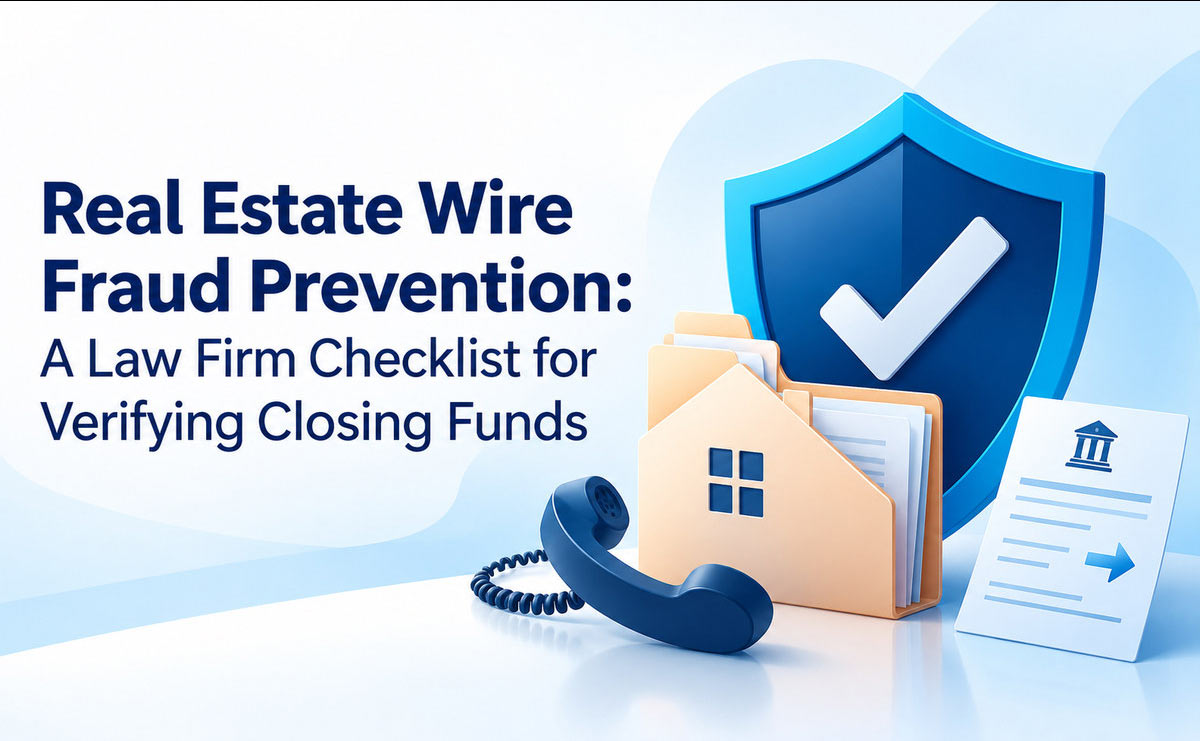
Real estate wire fraud prevention starts with a clear rule: check payment instructions through a trusted, independent channel before sending money. When the instructions change, pause and repeat the check.
This guide gives law firms a practical closing-funds workflow. It covers client warnings, trusted contacts, payment review, release approval, receipt checks, and a response plan. Use it alongside your bank’s procedures, professional rules, insurer guidance, and closing requirements.
What Is Real Estate Wire Fraud Prevention?
Real estate wire fraud prevention is the process of checking who requested a payment, where the funds should go, and who may approve release. It also includes checking receipt and acting quickly when something goes wrong.
Business email compromise, or BEC, involves a message that appears to come from a trusted source. The FBI’s BEC guidance includes a homebuyer receiving fake instructions for wiring a down payment. A convincing message can direct a real payment to the wrong account.
Cover money coming in and going out
Map both sides of the closing. Clients may send deposits or closing funds to the firm. The firm may send mortgage payouts, sale proceeds, or other amounts to another party.
Real estate wire fraud prevention should define who checks each movement. A warning sent to the buyer does not complete the firm’s checks on a later payout. Keep those tasks separate in the matter.
Also separate payment verification from formal client identification, source-of-funds review, and trust accounting. Those processes serve different purposes. A completed identity check does not prove that new account instructions are genuine.

Set the Verification Plan Before Closing Day
Build the plan when the file opens. Record the expected payees, key contacts, payment methods, and who can approve a change. This is easier to do before a rushed request arrives.
Include funds checks in your law firm file opening checklist. Mark a contact as verified only after completing the firm’s chosen process. A phone number copied from an email signature is not enough by itself.
Give clients one clear way to reach the firm
Explain how the firm will deliver payment instructions and how the client should confirm them. Ask the client to keep a trusted phone number from the start of the matter.
The Consumer Financial Protection Bureau’s closing-scam guidance advises homebuyers to arrange trusted contacts and discuss transfer protocols before closing. Use that idea to make the next action clear.
For example, tell clients to pause if a message changes the payee or account and call the established firm number. Explain what to do if no one answers. Give them a backup contact rather than leaving them to guess.
Real estate wire fraud prevention depends on a workable client process. Ask clients to explain the steps back in their own words. Save a brief note that the warning and contact plan were discussed.
A Real Estate Wire Fraud Prevention Checklist for Each Transfer
The checklist below is a suggested firm workflow. It draws on official fraud guidance, but its task labels and handoffs are editorial recommendations. It is not a prescribed form or a statement of the legal standard of care.
- Identify the matter, payment purpose, payee, amount, and currency.
- Save the exact instructions received and record their source.
- Reach the proper contact using independently verified contact details.
- Confirm the request and full payment details.
- Resolve changes, mismatches, and other concerns before proceeding.
- Obtain approval tied to the checked instructions.
- Compare the bank entry with the approved details before release.
- Record the transfer reference and check receipt through a trusted channel.
Use real estate wire fraud prevention as a release gate. If a required check is incomplete, show that status clearly and refer the issue to the responsible lawyer. Do not let a nearing bank cutoff turn an incomplete check into approval.
Check the Source and the Contact Details
Preserve the request as received, including any attachment with payment instructions. Record who sent it, when it arrived, and whether it differs from the earlier plan.
FCT’s Wire Validation Guide describes impersonation of lawyers, staff, lenders, and clients. It recommends using trusted contact details obtained independently when verifying wire payments.
Choose the contact route before making the call
Use a contact method already established through a reliable process. If a new firm or lender is involved, validate the contact through an independent, trustworthy source. Resolve uncertainty about the directory or website before relying on it.
Do not use a replacement phone number supplied in the same message as the changed bank details. In real estate wire fraud prevention, both details need scrutiny. Calling the fraudster’s number can make a false request appear checked.
Record the source of the number. “Called payee” leaves an important gap. A useful note states which contact was reached and how the firm established the contact route.
Treat forwarded instructions as a new input
A forwarded email from a known lawyer or agent still needs review. Identify the source of the payment instructions and confirm them with the appropriate party through the trusted route.
The Canadian Anti-Fraud Centre’s spear-phishing guidance describes messages that redirect payments by changing banking details. It advises checking unusual requests through known contact information.
Real estate wire fraud prevention should follow the payment request across handoffs. Avoid allowing a forwarded attachment to skip the review simply because the forwarding sender is familiar.
Confirm the Payment, Not Just the Person
Once you reach the right contact, confirm that they sent the instructions and are authorized to provide them. Then check the destination and purpose of the transfer.
Compare the payee, bank, full account details, amount, currency, and required reference. Use the identifiers needed for that banking route. Canadian institution and transit numbers, U.S. routing numbers, and international details are not interchangeable.
Read back the details and record discrepancies
Use a deliberate read-back process so both parties know which instructions are being checked. If a number or name differs, record the difference and refer it for review. Do not quietly fix the entry and continue.
The ALTA Outgoing Wire Preparation Checklist covers the instruction source, payment details, creator and authorizer, and delivery checks. It is a useful reference when designing the firm’s own record.
Real estate wire fraud prevention should also make the payment purpose clear. The approver needs to know what obligation the transfer addresses. A bank account that appears plausible is not a complete closing instruction.
Do not treat a familiar voice as proof
The Canadian Centre for Cyber Security warns that voice phishing can involve spoofed caller ID and cloned voices. An incoming call that sounds like a known person is not enough to authorize changed details.
End the unsolicited call and use the firm’s trusted contact process. If identity or authority remains uncertain, escalate it. Real estate wire fraud prevention needs a checked contact route as well as a conversation.

Understanding Real Estate Brokerage Agreements: Key Elements and Considerations
Stop and Reverify Changed Instructions
Any change to the payee, bank destination, account details, or relevant payment procedure should trigger fresh review. Keep the previous instructions so the reviewer can see what changed.
LAWPRO’s Wiring Funds Checklist directs firms to stop, involve a partner, and repeat verification when instructions change. It also calls for stopping when a verification step fails.
Give staff a clear escalation route
Define who handles a held payment and who acts if that lawyer is unavailable. Staff should be able to raise a concern without being expected to decide whether the closing can proceed.
Suggested statuses are Awaiting Check, Under Review, Approved for Release, Sent, and Receipt Confirmed. These are internal task labels, not bank statuses. Make the reason for a hold visible to the approved matter team.
Real estate wire fraud prevention should make a pause easy to enforce. A message from a senior person asking staff to skip the check is itself a reason to use the escalation route.
A hypothetical closing-day example
A seller’s payout email arrives shortly before the bank cutoff. It gives a new account and a new phone number. The clerk saves the request, marks the payment Under Review, and alerts the supervising lawyer.
The team calls through the contact route already established on the file. The known contact says the change was not authorized. No payment is released under those instructions.
This fictional example shows the value of a defined handoff. Real estate wire fraud prevention works better when staff knows how to pause and who makes the next decision.
Separate Preparation, Review, and Release
Ask your bank which controls it offers for payee setup, payment limits, and separate preparation and authorization. Agree on the firm’s approval process before relying on those controls.
Where staffing and banking tools allow, use a second authorized person to review the prepared payment against the checked instructions. Both people should use their own authorized access. Avoid making shared banking credentials part of the workflow.
Define each role’s responsibility
| Suggested role | Responsibility | Record to keep |
|---|---|---|
| Preparer | Collect instructions and prepare the payment | Source copy and proposed transfer details |
| Verifier | Check the contact, request, and destination | Contact route, outcome, and unresolved issues |
| Approver | Review the checked package and authorize release | Named approval for the exact instruction set |
| Receipt checker | Confirm delivery and follow up on exceptions | Bank reference and confirmed receipt |
These roles form a suggested policy. They do not override bank mandates or professional requirements. Some people may hold more than one role, but record who completed each step.
For solo firms, ask the bank and relevant advisers about suitable controls when a second internal reviewer is unavailable. Real estate wire fraud prevention should reflect the firm’s actual staffing rather than claiming a review that did not occur.
Use matter-linked task assignments to make review ownership visible. Tie approval to the exact saved instructions. A completed task called “check funds” is too vague to explain what was authorized.
Confirm Receipt and Monitor the Accounts
Save the bank’s transfer reference, time, amount, and destination details. Follow the agreed receipt-check process with the intended recipient through a trusted channel.
ALTA’s outgoing-wire checklist includes recording when funds were sent and received, and who confirmed receipt. Treat a receipt check as its own task rather than assuming the bank submission ends the work.
Follow up on missing or inconsistent receipt
If the recipient reports no payment or the information does not match, alert the responsible lawyer and contact the bank. Do not send a second payment just to solve the apparent delay.
Real estate wire fraud prevention includes watching for exceptions after release. Keep the bank’s response and the next action on the matter so another team member can follow the issue.
LAWPRO’s 2026 warning on unauthorized transfers encourages daily checks of trust and general accounts, especially around weekends and holidays. It also warns about unexpected authentication requests and calls purporting to come from a bank.
Bookkeeping supports a different control. Trust transaction records and reconciliation help connect movements to client ledgers. They do not establish that a payment destination was genuine before release.
Keep a Useful Verification Record
Store the record where the authorized matter team can find it. Use the firm’s approved access controls for bank details. Do not put full account information in task titles or broadly shared notifications.
A real estate wire fraud prevention record
A useful record links the received instructions, contact check, payment review, approval, and receipt outcome. It should show the people involved and the date and time of key steps.
Keep earlier instruction sets and note which one was approved. Record why a change required review and how it was resolved. Store any sensitive identifiers in the restricted record rather than repeating them everywhere.
For example, a task note might say: “New payout instructions held for lawyer review; see restricted verification record.” That points staff to the next action without copying the banking details into the task.
Real estate wire fraud prevention benefits from records that another person can understand. A checkbox is helpful only when the supporting information explains what was checked.

Act Immediately if Funds May Have Gone to the Wrong Account
Contact the sending bank’s fraud team immediately through a verified number. Explain the suspected fraudulent transfer and request an urgent stop or recall. Ask about steps to alert the receiving bank and freeze funds where possible. Give the transfer reference, amount, date, and destination details.
LAWPRO’s wrong-account response guidance stresses prompt action with the banks and insurer. Do not wait for a full internal investigation before making the urgent bank contact.
Run the response tasks in parallel
ALTA’s Rapid Response Plan, revised March 3, 2026, calls for a preplanned, coordinated response. Notify firm leadership and assign bank contact, technical response, reporting, and affected-party communication to named people.
Ask the sending bank to coordinate with the receiving bank. Where appropriate, alert the receiving bank’s fraud team too. If the client sent the wire, help them reach their bank with the relevant details; the account holder may need to act directly.
Preserve messages, attachments, email headers, instructions, transfer records, and response notes. Have the technical team contain suspected account access while preserving relevant evidence. Do not continue using a suspected compromised email thread to verify instructions.
Use the reporting route for the incident
In the United States, the FBI directs BEC victims to report through IC3 and immediately contact their financial institution. Record the report and bank reference numbers for follow-up.
In Canada, the Canadian Anti-Fraud Centre’s victim guidance calls for contacting the financial institution and local police. Its reporting page provides the national online reporting route. Preserve the police file number.
Notify applicable professional indemnity and cyber insurers promptly under their reporting terms. The responsible lawyer should assess any client, regulator, privacy, or other notice duties. Recovery is not guaranteed, and a report does not itself reverse a wire.
Real estate wire fraud prevention should include this response plan before a loss. Keep verified bank fraud contacts and backups available to the team.
Best Practices: Test the Process and Secure the Systems
Run a short exercise with a fictional changed-account request. Ask staff to find the trusted contact, hold the payment, locate the approver, and record the outcome. Then test what happens if the usual lawyer is away.
Review a sample of completed transfers for missing checks, unclear approvals, and absent receipt records. Use the findings to improve the workflow. Avoid measuring success only by whether a loss has occurred.
The Canadian Centre for Cyber Security’s social-engineering guidance recommends phishing-resistant multifactor authentication, staff training, and an incident response plan. Ask your technical provider to assess email, banking access, and other sensitive accounts.
Real estate wire fraud prevention needs both payment checks and system protection. For broader controls, see RunSensible’s law firm cybersecurity guide.
Common Mistakes to Avoid
Checking only the email appearance. A correct address, logo, or matter reference does not complete the verification process.
Calling the number in the changed instructions. Use the independently checked contact route instead.
Approving without the supporting record. Real estate wire fraud prevention needs approval tied to the exact instructions and completed checks.
Treating a bank reference as receipt. Complete the agreed check with the intended recipient.
Assuming a small test transfer proves safety. Do not let it replace the contact, destination, and approval checks.
Delaying the bank call during a suspected loss. Assign urgent response tasks while the facts are still being gathered.

Frequently Asked Questions
Should we check instructions from a familiar payee?
Yes. Familiarity should not bypass the firm’s transfer process. Confirm the instructions through the trusted contact route, especially when any details change. Real estate wire fraud prevention should apply consistently across the matter.
Is a secure portal enough to verify bank details?
A firm-approved portal can support delivery and recordkeeping. For real estate wire fraud prevention, still check the contact, request, destination, and authority to act. Do not treat upload alone as approval to release money.
Can a clerk complete the checks?
An authorized clerk can perform assigned checks within their role and the firm’s process. Give them a clear route for discrepancies and failed checks. The responsible lawyer handles the required legal and closing decisions.
What if changed instructions are legitimate?
Pause and reverify them through the trusted route. Record what changed and obtain the required new approval. A genuine change can follow the same controlled process without relying on urgency.
Does title insurance automatically cover wire fraud?
Do not assume coverage. Ask the relevant insurer to confirm the actual policy terms, exclusions, conditions, and reporting requirements. FCT’s title-insurance overview directs readers to the applicable policy for coverage and exclusions.
Can the bank always recover a fraudulent wire?
No recovery should be promised. Contact the bank immediately and request urgent action, then follow the reporting plan. Keep records of the request and follow-up while the bank and relevant authorities assess recovery.
Conclusion
Real estate wire fraud prevention works through clear checks, named responsibility, and a firm pause when details change. Verify the contact and payment, approve the exact instructions, and confirm receipt.
Start with one closing file. Make sure the team can find the trusted contacts, checked instructions, approval, and response plan. Fix any gaps before making the process routine.
RunSensible combines matter work with document storage, task management, and accounting. Its document management tools provide a place to organize instructions and supporting records. Task assignments help identify the next check and its owner.
Use these features to support the firm’s verification process and keep the review record connected to the matter. Confirm the access settings and workflow options available in your account. Bank controls and payment verification remain part of the firm’s operating process.
When reviewing the setup with your team, walk through a changed-instructions scenario. Check how the held payment, review, approval, and receipt record stay visible from start to finish.
Resources / External Sources
Official sources reviewed on October 8, 2026. Task labels, role assignments, and the hypothetical example are editorial recommendations, not claims about an actual firm or prescribed legal standards.
- FBI: Business Email Compromise — BEC, closing-payment scams, independent verification, and urgent bank contact.
- CFPB: Mortgage closing scams — Trusted contacts and transfer procedures agreed before closing.
- FCT: Wire Validation Guide — Impersonation risks and independently established contact details.
- Canadian Anti-Fraud Centre: Spear phishing — Changed bank details and checks through known contact routes.
- ALTA: Outgoing Wire Preparation Checklist — Instruction source, payment details, authorization, and receipt records.
- Canadian Centre for Cyber Security: Voice phishing — Spoofed caller ID and cloned voices.
- LAWPRO: Wiring Funds Checklist — Verification failures, changed instructions, and escalation.
- LAWPRO: Watch for unauthorized wire transfers — 2026 warning about account checks and unexpected authentication requests.
- LAWPRO: You transferred funds to the wrong account—what now? — Urgent bank, insurer, and technical response.
- ALTA: Rapid Response Plan for Wire Fraud Incidents — Plan revised March 3, 2026; coordinated response, bank action, and preserved evidence.
- FBI Internet Crime Complaint Center — U.S. internet-crime reporting destination.
- Canadian Anti-Fraud Centre: What to do if you are a victim — Financial institution, local police, and evidence preservation.
- Canadian Anti-Fraud Centre: Report fraud and cybercrime — Current national reporting route.
- Canadian Centre for Cyber Security: Social engineering — Phishing-resistant MFA, training, and incident response planning.
- FCT: Title insurance — Coverage and exclusions depend on the applicable policy.
Disclaimer: The content provided on this blog is for informational purposes only and does not constitute legal, financial, or professional advice.