Contents
What should employee offboarding cover?
Employee offboarding is the process of ending a person’s working access and duties while keeping the work and records the firm needs. For a law firm, ask whether someone else can safely carry on each matter.
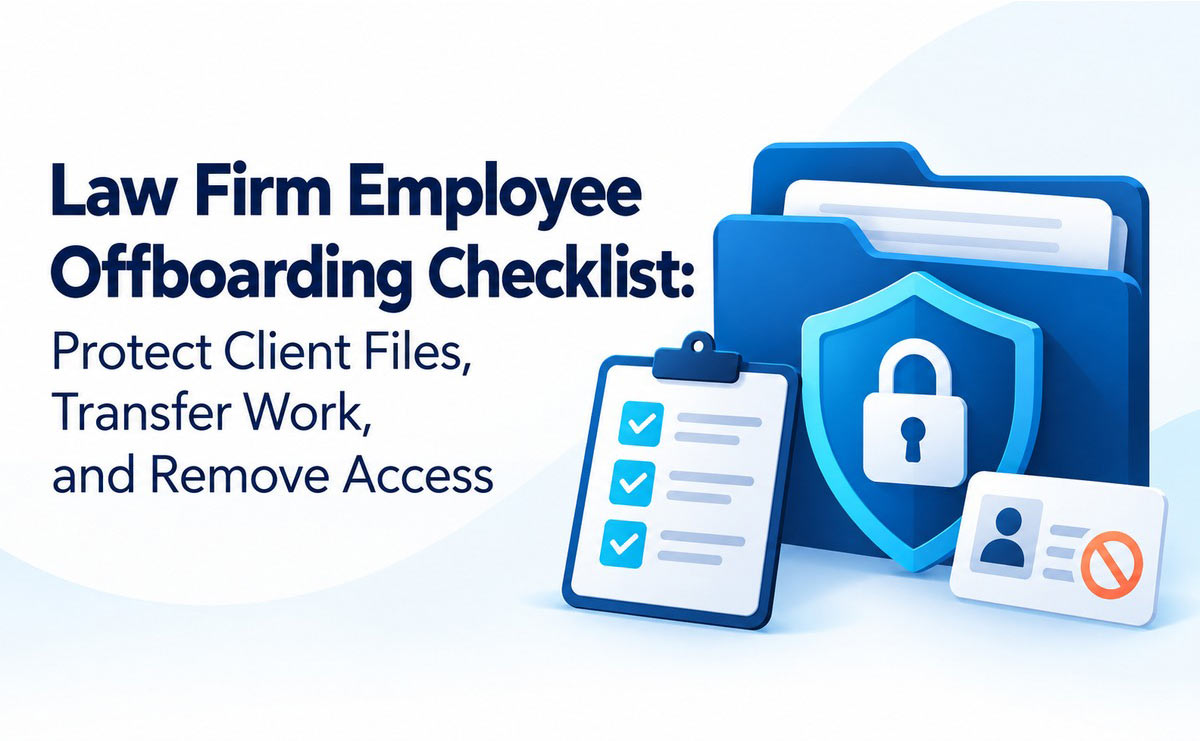
Use six checks as your starting point:
- Identify every affected matter and urgent commitment.
- Assign a new owner and confirm they accept the work.
- Preserve the records needed to continue and review that work.
- Remove physical and digital access at the approved time.
- Complete financial and personnel tasks with the right reviewers.
- Test the handover and record any unfinished items.
LAWPRO’s Employee Departure Checklist is a useful starting resource for legal practices. It also warns that deleting accounts can lose information needed for an audit or review. Treat account closure and record preservation as coordinated decisions.
Set ownership and timing before the last day
Name one employee offboarding coordinator
Choose one person to track progress across the firm. In a small practice, this may be the office manager or a partner. Give that person the power to chase updates and flag open issues.
The coordinator tracks the process. The supervising lawyer decides legal responsibility, the IT administrator handles system controls, and the payroll contact checks employment records. One person may fill several roles, but record which role approves each decision.

Limit who can read the departure record. Colleagues need work assignments and contact details. They rarely need to read private staff notes or know why someone left.
Choose the sequence for the situation
For a planned departure, use the notice period to review files and brief replacements. Schedule the access cut-off, device return, and client communications together.
For a sudden departure, secure access and preserve records promptly. Assign short-term cover before trying to piece together every detail. Where departure concerns involve misconduct or a dispute, have counsel and IT agree on evidence preservation and access controls before deleting or wiping anything.
The following is a suggested planning framework, not a legal timetable:
| Phase | Lead role | Evidence to keep |
| Before departure | Coordinator and supervising lawyer | Matter list, owners, approved timing |
| At access cut-off | IT administrator | Account actions and unresolved exceptions |
| First review after departure | Receiving team | Opened files and confirmed next steps |
| Final closure | Responsible partner | Completed review and remaining work assigned |
Set review dates that fit the risk. A closing tomorrow needs a different response from a routine file with no near-term event.
Put the employee offboarding checklist into action
1. Build the list of affected work
Start with matters assigned to the person. Then review shared matters, consultations, delegated tasks, and work awaiting approval. Include upcoming events, overdue items, and promises made outside the task system.
Ask the team to identify work that does not appear on the main matter list. An assistant may manage a partner’s inbox, collect signatures, or track originals without being named as the matter owner.
For each item, record the matter reference, current owner, receiving owner, next action, due date, and source of that date. Add a separate list of firm duties such as supplier renewals and office administration.
Put urgent items first. The aim of this employee offboarding step is a reliable view of unfinished work, including work that was never formally assigned.
2. Prepare a useful matter handover
A handover note should explain the next step and where to find the key records. A folder of documents alone may leave the receiving person guessing.
Use the same short fields for each matter:
- Current position and the client’s latest instructions.
- Next action, owner, and verified due date.
- Outstanding documents, approvals, or responses.
- Key contacts and any communication needs.
- Location of current drafts, originals, and relevant correspondence.
- Issues that need the supervising lawyer’s review.
Keep legal analysis and client details within the appropriate matter record. Link to it in the departure tracker. Keep private client details out of the general staff file.
For context that could help future work, use a separate, approved knowledge process. RunSensible’s guide to law firm knowledge management explains how to preserve reusable guidance without copying whole client files into a shared knowledge base.
3. Confirm the receiving person accepts responsibility
Reassigning a task is the start of a handover. Ask the receiving person to review the note, open the linked files, and confirm the next action.
Check they have time and access to do the work before closing the transfer. If they cannot take the work, the coordinator should return the item to the supervising lawyer for a decision.
For important deadlines, record who checked the underlying source and when. Transfer calendar responsibility, reminders, and meeting ownership where needed. Review changes with the person responsible for the matter.
RunSensible’s matter management tools connect documents, notes, events, and other work to the matter. That can give the receiving team a common place to review the handover. The firm still needs to check the records and approve responsibility changes.
4. Preserve client and firm records
Find work stored in the person’s mailbox, cloud folders, local downloads, approved messaging tools, and physical workspace. Decide which records belong in the matter file or another approved place.
The Government of Canada’s guidance on employee departure or transfer addresses public-sector information management. Its separation of useful records from personal and temporary material offers a practical organizing model. Its specific rules and timelines do not govern private law firms.
Have the firm’s records lead approve what to keep and for how long. Review your client file retention approach before deleting records. Check for litigation holds, complaints, and other reasons to preserve evidence. Keep affected records even if routine deletion would otherwise be due.

Law Firm Capacity Planning: Balance Workloads and Plan Hiring
5. Review every access route
Build the access list from actual systems, account records, and the person’s role. Ask the administrator to check the main identity account as well as applications with separate logins.
Include practice software, email, cloud storage, remote access, signing tools, finance systems, and portals used for the person’s work. Check guest memberships, recovery contacts, delegated permissions, shared credentials, and connected applications where relevant.
Microsoft’s guidance on revoking user access explains that applications can control their own sessions. A change at the identity provider may not immediately end every application’s access. Follow the current instructions for each service and verify the result.
For employee offboarding, separate the cut-off time from the time all controls are confirmed. Record any delay, its cause, interim protection, and the person responsible for follow-up. Do not describe access as fully removed while an exception remains open.
6. Secure accounts without losing necessary data
Use the provider’s supported process to block sign-in, revoke sessions, and remove permissions. Review shared secrets known to the departing person and replace them where needed. Make an approved firm contact the person who can recover business accounts.
Do not collect personal passwords or ask a colleague to log in as the person who left. Use authorized administrative access and named replacement accounts so later work has a clear author.
For Microsoft 365, the official former-employee process treats access removal, mailbox preservation, data access, licensing, and account deletion as separate steps. Have your administrator check retention and licensing needs before removing a licence or deleting an account.
This is a useful employee offboarding principle across systems: confirm how the firm will retain and retrieve necessary records before approving permanent deletion. Record the decision and its approver.
7. Recover devices and address local copies
Record each returned firm device, its asset number, condition, and custodian. Include relevant keys, passes, cards, and physical records in the return process.
The Canadian Centre for Cyber Security’s personnel termination control brings together access removal, credential revocation, property return, and continued organizational access to information. It is a security reference, not a law-firm-specific legal requirement.
For a personal device, follow the firm’s approved device policy and obtain the necessary authority before any removal action. Distinguish firm information from personal content. Do not approve a full device wipe by default.
Account changes do not retrieve a printed file or an existing local copy. Record how those materials will be returned, preserved, or removed. If a device or file is missing, flag it for employee offboarding follow-up.
8. Route future messages and update ownership
Choose who will receive future business messages and how urgent requests will be handled. Have the responsible person approve an appropriate auto-reply, delegation, or other routing arrangement.
Review active booking links, meeting invitations, form notifications, and recurring reminders. A message may reach the firm while still being assigned to someone who has left.
Check whether scheduled workflows depend on the person’s account or permissions. Ask the administrator to transfer ownership through supported controls. Use a test submission or other authorized check to confirm that the replacement receives the work.
Keep employee offboarding messages factual. Share only what each person needs to know. Check any forwarding plan against confidentiality, privacy, and access restrictions. Avoid sending every message to a broad distribution list.
9. Review financial and personnel items
Ask the appropriate reviewers to reconcile outstanding time entries, expenses, firm property, purchasing authority, and personnel records. Send payroll and benefit questions to the people responsible for those obligations.
If the employee had finance duties, review bank access, payment approvals, supplier contacts, and signing authority with the relevant institutions. Keep changes to financial permissions distinct from decisions about client funds.
A departure does not itself authorize a transfer from trust. Have the responsible lawyer and finance lead review client-money instructions under the applicable rules and the firm’s controls.
Use employee offboarding to find unfinished financial work and name its next owner. Keep pay details within the private staff process. The general matter handover needs only the information required to continue client work.
Add legal review when a lawyer leaves
Respect the client’s choice
A departing lawyer’s matters need more than an internal staff reassignment. The ABA’s guidance on ethically changing law firms emphasizes notice, client choice, confidentiality, and conflict review. It discusses the U.S. Model Rules framework; check the rules that apply where your firm practises.
Have the responsible lawyers agree on client communications where possible. Record each client’s instructions and the approved destination for any transfer. Keep staff disputes out of routine client updates.
Employee offboarding should not presume that every client stays with the firm or follows the departing lawyer. Track unanswered notices separately so someone remains responsible for follow-up and urgent work.
Check formal steps before marking a transfer complete
Changing a name in the system does not end or transfer a lawyer’s role. The ABA’s Model Rule 1.16 addresses tribunal permission where required and steps to protect client interests when representation ends. Local rules control the actual process.
Ask the supervising lawyer to identify required notices, consents, filings, or orders. Track the status of each action. Where files move outside the firm, record the authorized recipient, material sent, transfer method, and receipt.
Keep copies only as permitted and required. The employee offboarding coordinator records completion after the responsible lawyer confirms the legal steps.
Test the handover with a real workflow
Use the employee offboarding checklist for a closing file
Consider this hypothetical example. A conveyancing assistant leaves while two property matters remain open. The new assistant gets the folders. Yet one lender’s instructions are still in the former assistant’s email. A signing appointment also uses a booking link tied to that assistant.
Test the transition by asking the replacement to explain the next step on each matter. They should locate the relevant instructions, confirm the appointment, and identify the lawyer reviewing the work. Any missing information becomes a named task with a due time.
Next, check the communication route. Send an approved test message or booking request without real client details. Confirm it reaches the right person and appears in the expected work queue.

This employee offboarding test checks whether work can continue. It does not prove that every record or permission is correct. Use the same approach to check the other systems and matters.
Close the process with an exception record
For each unresolved item, record the problem, current protection, owner, due date, and person who can approve closure. Examples include a missing device, an unanswered client notice, or a vendor still processing an access request.
Mark employee offboarding complete only when the required work is verified and any continuing tasks have an approved owner. Keep the evidence references in a restricted record.
Best practices and common mistakes
Prepare for departures while people are still working. Use firm-controlled accounts, clear matter ownership, and shared records with suitable access. These habits make employee offboarding easier to manage when notice is short.
Avoid treating a signed checklist as proof by itself. Link important actions to an administrator’s record, a receiving person’s confirmation, or an approved file-transfer receipt. Check the evidence without collecting unnecessary sensitive material.
Do not confuse an empty task list with a complete handover. Search for pending approvals, draft work, and future events. Ask receiving staff what they still cannot find.
After the departure, choose one lesson to improve the process. A missing supplier contact might lead to a better contact register. Repeated access delays might justify a clearer system inventory. Keep improvements specific and achievable.
Recommended RunSensible Features
RunSensible connects matter records, documents, tasks, calendars, and billing within one practice management platform. Use that shared context to support employee offboarding and check what the receiving team still needs.
Documents and tasks tied to the matter
Document management gives the team a place to store and find matter files. Agree on where the handover note belongs and check that the new owner can open its links.
Task management supports assigned work, due dates, and reminders. Use it to track the next step and follow-up review. Ask your administrator how account changes affect your setup; removing access across the firm’s other systems remains a separate task.
Frequently Asked Questions
Who should lead employee offboarding in a small law firm?
Name one coordinator, usually a manager or partner. Keep legal, IT, and payroll approvals with the appropriate people. If one person fills several roles, record each decision clearly.
Should we delete the employee’s account on their last day?
Access restriction and deletion are separate decisions. Confirm retention, retrieval, ongoing message handling, and preservation needs first. Follow the provider’s current process and the firm’s approved timing.
What if the employee leaves without a handover?
Assign urgent coverage, preserve records, and review calendars and pending work. Build the missing handover from approved sources. Record gaps for the supervising lawyer instead of assuming the file is complete.
Can the replacement use the former employee’s login?
Use a named account with approved permissions. Have an administrator provide supported access to necessary records. This keeps new activity attributable to the person doing the work.
Can a departing lawyer take copies of client files?
Do not treat that as an automatic entitlement. The responsible lawyers should review client instructions, confidentiality, applicable rules, and transfer arrangements. Keep an approved record of what moves and to whom.
Should contractors follow the same departure process?
Apply the relevant records, work-transfer, and access checks to anyone whose access ends. Review contract terms and responsibilities separately. A vendor or temporary worker may hold access that never appeared in the employee directory.

Conclusion
A useful employee offboarding process ends with evidence that work can continue and access has been addressed. Keep a named owner for each matter, preserve necessary records, and verify the receiving team’s next steps.
Start by testing your checklist against one departure scenario. Use a few typical matters and systems to find gaps, then update the process. Connected practice tools can support that work when the firm’s responsibilities, approvals, and records are clear.
Resources
- LAWPRO and practicePRO — Employee Departure Checklist. 2016 reference checklist; account preservation and departure planning.
- Government of Canada — Guidance on Employee Departure or Transfer. Public-sector information-management model; not a rule for private law firms.
- Microsoft Learn — Revoke user access in an emergency in Microsoft Entra ID. Application sessions and identity-provider revocation limits.
- Microsoft Learn — Overview Remove a former employee and secure data. Separate account, mailbox, data, licence, and deletion decisions.
- Canadian Centre for Cyber Security — ITSG 33 Annex 3A PS 4 Personnel Termination. Security reference for access, property, and continued records access.
- American Bar Association — Practical Guidance for Ethically Changing Law Firms. 2025 discussion of client notice, choice, confidentiality, and transfers.
- American Bar Association — Model Rule 1.16 Declining or Terminating Representation. Tribunal permission and protection of client interests; local rules control.
Disclaimer: The content provided on this blog is for informational purposes only and does not constitute legal, financial, or professional advice.