Contents
Modern E-Discovery is reshaping the outcome of litigation as more business information is transmitted through digital systems. Emails, cloud documents, mobile communications, and collaboration tools now contain a substantial portion of the records relevant to legal disputes, investigations, and litigation.
Organizations conduct daily operations through platforms like Microsoft Teams, Slack, cloud storage services, and mobile devices. As a result, the identification and production of digital evidence have become more complex and more significant to litigation outcomes.
For many years, organizations treated e-discovery as a reactive support function managed primarily by outside vendors and litigation support teams. That approach has shifted as courts, regulators, and corporate clients place greater emphasis on defensible discovery procedures, cost control, and procedural transparency.
E-discovery now plays a direct role in litigation strategy, compliance, and risk management from the earliest stages of a matter. Legal teams increasingly treat discovery as an operational process that requires coordination between legal, technical, and compliance personnel.
The Data Expansion Reshaping Litigation Practice
The growth of digitally stored information has changed discovery obligations. Legal teams must now manage evidence across multiple platforms, systems, and data environments while maintaining defensible and time-effective discovery procedures.
The Shift from Email to Multi-Platform Evidence
A decade ago, most discovery obligations focused primarily on corporate email archives. Legal teams typically identified relevant custodians, preserved email accounts, collected data, and processed the material through review platforms using relatively standardized procedures. Although discovery presented technical and legal challenges, the underlying data environment remained largely centralized and predictable.
Modern businesses generate discoverable information across multiple communication systems, cloud platforms, and operational applications. Internal communications frequently occur through platforms such as Slack and Microsoft Teams, where messages, shared files, edits, and metadata may all become relevant evidence. Organizations also rely on cloud-based platforms such as Google Workspace, SharePoint, and OneDrive for document management and collaboration. Mobile messaging applications, video conferencing systems, customer relationship management platforms, and enterprise operational systems now routinely contain potentially relevant data.
Modern discovery obligations therefore extend beyond traditional document collection. Legal teams must address version histories, access logs, deleted content, structured data, cloud storage records, and communications distributed across multiple systems and custodians. Relevant information may exist simultaneously across company infrastructure, third-party platforms, and personal devices. Strong cybersecurity practices have become essential for Law firms technology today managing sensitive litigation data.
Breakdown of Traditional Discovery Workflows
Traditional discovery workflows were designed for centralized and email-focused environments. Many organizations relied on manual legal hold processes, custodian self-collection, and sequential coordination between legal teams and external vendors. Those procedures become significantly less effective when data exists across numerous platforms with different retention settings, export limitations, and data structures.
Collection from collaboration platforms introduces additional procedural challenges. Unlike email systems, collaboration tools may require platform-specific collection methods and administrative access. Messages, shared files, deleted content, and channel activity may each follow different retention policies and technical formats. Inconsistent collection procedures increase the risk of incomplete productions, preservation failures, and disputes regarding the scope or accuracy of discovery efforts.
Chain of custody requirements also become more difficult to maintain in fragmented data environments. When multiple parties collect information from different systems at different times, organizations may struggle to establish a complete and defensible audit trail. This creates increased exposure during discovery disputes, regulatory reviews, and court challenges involving preservation or production practices.
Operational and Financial Impact
Inefficient discovery workflows create direct operational and financial consequences for litigation teams. Manual review processes, fragmented collections, and inconsistent workflows increase staffing requirements, extend review timelines, and elevate the risk of sanctions, adverse inference findings, and production disputes.
Clients increasingly evaluate outside counsel based not only on legal outcomes, but also on cost predictability and operational control. When discovery costs become difficult to forecast or when discovery disputes arise from incomplete or inconsistent productions, outside counsel credibility may be affected regardless of the merits of the underlying case.
The expansion and fragmentation of electronically stored information have fundamentally changed the operational demands of litigation discovery. Legal teams that continue to rely on outdated discovery procedures may face increased costs, reduced efficiency, and greater litigation risk compared to organizations that implement structured and defensible discovery operations.
The Shift from Litigation Support to Strategic Legal Operations
Modern E-Discovery now plays a central role in litigation readiness, risk management, compliance, and client service delivery, driven by growing client expectations for efficiency, defensibility, and measurable operational performance.
Modern E-Discovery as Part of the Matter Lifecycle
Progressive legal teams no longer treat discovery as a process that begins after litigation is filed. Instead, Modern E-Discovery is integrated into the earliest stages of matter assessment and case strategy.
Today, firms increasingly incorporate data mapping, information governance review, and preservation planning into Early Case Assessment (ECA). Matter intake processes commonly identify key custodians, data repositories, communication platforms, cloud applications, and messaging tools at the outset of a matter. This early visibility allows legal teams to evaluate litigation exposure, estimate discovery costs, implement defensible legal holds, and shape litigation strategy before formal discovery begins.
How firms conduct Modern E-Discovery also depends on greater cross-functional collaboration. Litigation attorneys, IT and cybersecurity personnel, compliance teams, information governance professionals, and legal operations specialists now work together through unified matter teams with clearly defined responsibilities and workflows. These established communication channels improve consistency, reduce delays, and strengthen defensibility throughout the discovery process.
Importantly, Modern E-Discovery has expanded beyond litigation alone. Data generated through compliance reviews, internal investigations, privacy audits, and cybersecurity assessments increasingly informs litigation strategy and discovery planning. As a result, discovery is no longer viewed as a standalone legal task, but as part of broader enterprise risk and governance management.
The Growing Role of Legal Operations in Litigation Management
The rise of legal operations has fundamentally changed how litigation and Modern E-Discovery are managed. Legal operations professionals bring process management, analytics, technology oversight, and workflow optimization to functions that were historically driven by individual attorney judgment and ad hoc practices.
This shift has accelerated the standardization of discovery workflows. Many firms and corporate legal departments now maintain formal discovery playbooks that establish consistent procedures for litigation holds, custodian interviews, data collection, review protocols, quality control, privilege logging, and productions. Automated workflows increasingly manage preservation notices, route collected data into review environments, and track progress through centralized reporting dashboards.
Standardization provides several operational advantages. It reduces inefficiencies, improves defensibility through documented and repeatable processes, and enables meaningful performance measurement across matters. Sophisticated legal operations teams routinely monitor Modern E-Discovery metrics such as collection timelines, cost per gigabyte processed, review throughput rates, culling efficiency, privilege log accuracy, and production error rates.
Legal operations Softwares by integrating analytics, automation, and continuous process improvement into discovery workflows, help transform Modern E-Discovery into a scalable operational function with measurable KPIs and long-term efficiency goals.
Why Clients Expect Greater Operational Sophistication
Corporate legal departments are driving much of this transformation. Over the past decade, in-house legal teams have evolved into highly accountable business units expected to manage costs, demonstrate efficiency, and deliver measurable value. As legal operations capabilities within corporate legal departments have matured, clients have become far more sophisticated in evaluating outside counsel.
Today, law firms are assessed not only on legal expertise, but also on their ability to manage Modern E-Discovery efficiently and defensibly. Outside counsel evaluations increasingly examine workflow documentation, project management capabilities, technology adoption, reporting transparency, responsiveness, and cost predictability.
Clients now expect firms to provide realistic discovery budgeting, transparent Early Case Assessments, defensible workflows, and real-time reporting on discovery progress and costs. At the same time, many corporate legal departments face growing matter volumes alongside constrained budgets, creating significant pressure to improve efficiency and control discovery spend.
These expectations have also accelerated the use of alternative legal service providers (ALSPs), many of which offer technology-enabled Modern E-Discovery solutions focused on scalability and cost efficiency. In this environment, firms that invest in operational discipline, integrated technology, and measurable discovery performance gain a significant competitive advantage.
Ultimately, Modern E-Discovery has evolved from a reactive support function into a core component of strategic legal operations. Firms that treat discovery as an integrated operational discipline — rather than an isolated litigation task — are better positioned to manage risk, control costs, and meet the increasingly sophisticated expectations of corporate clients.
Core Technologies Driving Modern E-Discovery
Modern E-Discovery is increasingly shaped by integrated, cloud-based, and analytics-driven technologies designed to manage growing data volumes, distributed workforces, and increasingly complex communication environments. As litigation data expands across cloud platforms, collaboration tools, mobile devices, and global repositories, firms are modernizing their discovery infrastructure to improve scalability, defensibility, efficiency, and speed to insight.
Cloud-Based Modern E-Discovery Platforms
The migration to cloud-based infrastructure has become one of the most significant developments in Modern E-Discovery. Traditional discovery workflows relied heavily on on-premises servers, physical media transfers, and location-dependent review environments, all of which introduced delays, operational friction, and infrastructure costs.
Modern E-Discovery cloud platforms such as RelativityOne, Everlaw, Logikcull, and Onna allow firms to:
- Scale processing and review capacity on demand
- Support geographically distributed legal teams
- Reduce infrastructure and maintenance costs
- Improve collaboration across offices and jurisdictions
Centralized cloud environments also streamline Modern E-Discovery workflows by eliminating manual data transfers and reducing coordination delays between legal teams, vendors, and clients.
At the same time, security and governance remain critical considerations in Modern E-Discovery cloud deployments. Because discovery frequently involves highly sensitive corporate and personal data, firms must carefully evaluate:
- Encryption standards
- Access controls and authentication protocols
- Audit logging capabilities
- Incident response procedures
- Regulatory certifications such as ISO 27001 and FedRAMP
While leading cloud providers often deliver stronger infrastructure security than legacy on-premises systems, firms still retain responsibility for governance, vendor oversight, and compliance management.
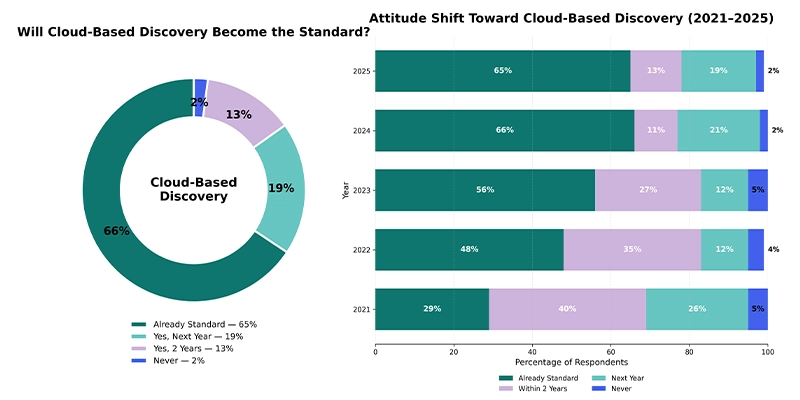
Figure: In a 2025 survey, 65% of respondents said cloud-based e-discovery is already their standard, with nearly all others adopting it within 1–2 years
Integrated Modern E-Discovery Technology Ecosystems
Modern E-Discovery no longer functions effectively as a standalone software solution. Historically, law firms operated fragmented systems for practice management, document management, billing, compliance tracking, and discovery, creating redundant workflows, inconsistent reporting, and defensibility risks.
To address these inefficiencies, firms are increasingly building integrated Modern E-Discovery ecosystems that connect legal technologies through APIs, shared metadata structures, and automated workflows.
In a unified Modern E-Discovery environment:
- Matter management systems can initiate legal holds automatically
- Cloud repositories synchronize directly with review platforms
- Compliance and HR systems support preservation workflows
- Data moves continuously through the litigation lifecycle
This interoperability significantly improves operational efficiency by reducing manual handoffs, duplicate data entry, and reporting inconsistencies. It also preserves metadata and chain-of-custody information more effectively, strengthening defensibility throughout the Modern E-Discovery process.
Integrated ecosystems also improve the performance of analytics and AI tools by allowing them to operate on unified datasets rather than fragmented information silos. As a result, interoperability has become a central requirement in Modern E-Discovery platform selection and technology procurement.
Advanced Analytics and Modern E-Discovery Review Capabilities
Modern E-Discovery platforms now extend far beyond traditional keyword searching. Advanced analytics and Technology-Assisted Review (TAR) have become standard components of modern review workflows, helping legal teams identify relevant evidence more efficiently while reducing the cost and duration of document review.
Contemporary Modern E-Discovery platforms commonly include capabilities such as:
- Concept clustering
- Email threading
- Near-duplicate detection
- Communication mapping
- Timeline analysis
- Metadata analytics
- Entity recognition
- Predictive coding
These technologies fundamentally change the economics of review. Rather than relying solely on linear attorney review models, Modern E-Discovery platforms use machine learning and analytics to prioritize likely relevant content and eliminate clearly nonresponsive material early in the process.
Artificial intelligence is also playing a growing role in Modern E-Discovery workflows, supporting tasks such as document summarization, issue identification, privilege analysis, and evidence clustering. The objective is not to replace legal judgment, but to accelerate insight generation, improve consistency, and allow attorneys to focus on higher-value legal analysis and litigation strategy.
Firms that can move efficiently from data collection to actionable evidence are better positioned to assess litigation risk, evaluate settlement exposure, and develop informed case strategies under increasingly compressed timelines.
Mobile Data Collection and Collaboration Challenges in Modern E-Discovery
One of the most technically complex areas of Modern E-Discovery involves collecting and preserving data from mobile devices, collaboration platforms, and ephemeral messaging applications.
Business communications now routinely occur across platforms such as Microsoft Teams, Slack, WhatsApp, Zoom, Google Chat, and personal mobile devices — many of which were not designed with traditional discovery requirements in mind.
Several challenges continue to shape Modern E-Discovery collection workflows:
- Ephemeral messaging applications may automatically delete communications before preservation measures are implemented.
- Each platform maintains unique export methods, metadata structures, and collection limitations.
- Bring-your-own-device (BYOD) environments create privacy, consent, and governance complications.
- Data from multiple communication platforms must be normalized into consistent reviewable formats.
A Slack conversation, Teams chat, WhatsApp exchange, and email thread may all relate to the same issue, yet each contains different metadata structures, timestamps, attachment formats, and contextual elements. Preserving that information accurately while maintaining defensible chain-of-custody documentation is essential to Modern E-Discovery defensibility.
As communication ecosystems continue to evolve, Modern E-Discovery increasingly depends on integrated operational infrastructure capable of managing diverse data sources within a unified governance and review framework. Firms that successfully modernize these capabilities are better positioned to reduce risk, improve efficiency, and respond effectively to the growing complexity of modern litigation data.
Cybersecurity, Compliance, and Data Governance
As Modern E-Discovery environments become more data-intensive and globally distributed, cybersecurity, privacy, and governance concerns have become central to litigation operations. Discovery workflows routinely involve the collection, transfer, and review of highly sensitive information across multiple systems, vendors, and jurisdictions, creating significant legal, regulatory, and operational risk if not managed effectively.
Cybersecurity and Privacy Risks in Modern E-Discovery
Modern E-Discovery datasets often contain highly sensitive materials, including trade secrets, executive communications, financial records, personal data, healthcare information, and confidential business strategy documents. Because these datasets are frequently aggregated into centralized review environments, discovery itself can become a concentrated security risk.
Third-party vendor exposure remains one of the most significant concerns. Modern E-Discovery workflows commonly involve multiple external providers responsible for data collection, hosting, processing, analytics, and production support. A security incident affecting any participant in that ecosystem can compromise privileged information, expose confidential client data, and create substantial reputational and regulatory consequences.
Ransomware attacks have intensified these concerns, particularly as law firms and legal service providers have become increasingly attractive targets due to the sensitivity and volume of the information they manage. Discovery repositories, especially those maintained outside core enterprise systems, require dedicated security oversight and continuous monitoring.
To reduce these risks, organizations are embedding cybersecurity controls directly into Modern E-Discovery workflows through measures such as:
- Encryption of data at rest and in transit
- Strict access management and authentication controls
- Continuous activity logging and audit monitoring
- Security testing and vendor due diligence
- Segregated environments for highly sensitive matters
Modern E-Discovery now requires close coordination between legal, cybersecurity, compliance, and technology teams to ensure that litigation workflows remain defensible without increasing organizational exposure.
Cross-Border and Regulatory Challenges in Modern E-Discovery
Cross-border litigation has significantly increased the regulatory complexity of Modern E-Discovery. Organizations must now navigate overlapping privacy, data transfer, and industry-specific compliance obligations across multiple jurisdictions.
Regulatory frameworks such as GDPR, PIPL, LGPD, and sector-specific requirements like HIPAA and financial services regulations impose strict controls on how personal and regulated data can be transferred, reviewed, and produced during litigation.
One of the primary challenges in Modern E-Discovery is balancing U.S. discovery obligations against international privacy restrictions. In many cases, legal teams must comply simultaneously with court-ordered production requirements and foreign data protection laws that limit cross-border transfers.
To manage this complexity, firms increasingly:
- Conduct early data residency and jurisdictional assessments
- Apply targeted anonymization and redaction protocols
- Use region-specific hosting and review environments
- Coordinate with local counsel on jurisdictional requirements
- Incorporate privacy review into discovery workflows from the outset
For multinational organizations and highly regulated industries, cross-border Modern E-Discovery has evolved into a specialized operational capability requiring both legal and technical expertise.
Defensible Governance Frameworks in Modern E-Discovery
Effective Modern E-Discovery depends on governance frameworks that are established before litigation arises and consistently applied across matters. Organizations are increasingly moving away from reactive discovery management toward formalized governance structures designed to support defensibility, compliance, and operational consistency.
Core elements of a defensible Modern E-Discovery governance framework include:
- Clearly documented retention and preservation policies
- Standardized legal hold procedures
- Data classification and governance protocols
- Comprehensive audit trails and chain-of-custody documentation
- Defined approval and escalation workflows
- Ongoing vendor oversight and risk management
Auditability remains particularly important. Organizations must be able to demonstrate how discoverable information was preserved, collected, reviewed, and produced throughout the matter lifecycle.
Vendor governance has also become a central component of Modern E-Discovery risk management. Many firms now conduct formal assessments of discovery providers focused on cybersecurity posture, incident response capabilities, compliance certifications, and operational controls.
Increasingly, organizations are integrating Modern E-Discovery governance into broader enterprise risk, privacy, and compliance strategies rather than treating discovery as a standalone litigation function. Firms that adopt this integrated approach are better positioned to manage regulatory exposure, strengthen defensibility, and maintain client trust in increasingly complex data environments.

Common Operational Challenges in Modern E-Discovery
Despite significant advances in technology, many organizations continue to face operational barriers when modernizing discovery workflows. In most cases, the challenge is not the lack of available Modern E-Discovery solutions, but the difficulty of replacing fragmented systems, inconsistent processes, and deeply embedded working habits. Successful modernization requires not only technology investment, but also operational alignment, governance discipline, and long-term change management.
Legacy Systems and Workflow Fragmentation in Modern E-Discovery
Many firms still operate within fragmented technology environments built incrementally over years of litigation practice. Discovery, document management, matter management, and compliance systems often function independently, requiring manual coordination at multiple stages of the Modern E-Discovery process.
In these environments:
- Data may be collected in one platform and manually transferred to another for processing or review
- Custodian metadata often requires manual reconciliation
- Teams rely on disconnected workflows across legal staff, IT personnel, and external vendors
- Informal “shadow processes” emerge outside standardized governance structures
This fragmentation creates several operational risks:
- Increased administrative overhead
- Delays caused by repeated manual handoffs
- Greater likelihood of processing or transfer errors
- Inconsistent audit trails and documentation
- Higher exposure to data leakage and defensibility challenges
As litigation data volumes and complexity continue to grow, fragmented Modern E-Discovery workflows become increasingly difficult to scale efficiently or defend consistently.
Change Management and Adoption Challenges
Technology investments alone rarely modernize discovery operations successfully. One of the most persistent obstacles in Modern E-Discovery transformation is organizational resistance to workflow standardization and process change.
Legal professionals often develop highly individualized approaches to discovery management based on prior experience, preferred vendors, or informal operational practices. As a result, standardized workflows and centralized governance models may initially be viewed as limiting flexibility rather than improving efficiency.
Common adoption challenges include:
- Resistance to new technologies and workflows
- Reluctance to abandon familiar review methods
- Limited understanding of analytics and automation tools
- Ongoing training requirements as platforms evolve
- Misalignment between legal, IT, compliance, and operations teams
Effective Modern E-Discovery modernization requires sustained leadership support and cross-functional collaboration. Organizations that involve attorneys, legal operations professionals, IT, and compliance stakeholders in process design tend to achieve stronger adoption and more durable operational improvements.
Pilot programs, transparent communication, and measurable operational results are often critical to building internal confidence in new Modern E-Discovery workflows.
Vendor Consolidation and Modern E-Discovery Technology Evaluation
Another major operational challenge in Modern E-Discovery is technology sprawl. Over time, many firms accumulate multiple specialized tools for legal holds, collections, processing, analytics, review, and production, often purchased independently to solve isolated operational problems.
This fragmented vendor landscape creates several challenges:
- Overlapping functionality across platforms
- Increased integration complexity
- Higher administrative and licensing costs
- Greater training and support burdens
- Reduced operational consistency across matters
In response, many organizations are moving toward vendor consolidation and more unified Modern E-Discovery infrastructure strategies.
Modern platform evaluations increasingly focus on factors beyond feature lists alone, including:
- Scalability for large and complex matters
- Integration capabilities with existing systems
- Security and compliance standards
- Vendor stability and long-term product roadmap
- Quality of implementation, support, and training services
Firms that successfully consolidate Modern E-Discovery functionality onto fewer integrated platforms often reduce operational friction, improve workflow consistency, and lower long-term total cost of ownership.
Increasingly, leading organizations are shifting away from treating Modern E-Discovery software as isolated point solutions and toward viewing discovery technology as part of a broader operational infrastructure supporting litigation readiness, governance, and enterprise risk management.
The Future of E-Discovery and Litigation Operations
The future of litigation management is moving toward continuous readiness, integrated governance, and increasingly automated legal solutions. As legal data environments grow more complex, organizations are shifting away from reactive discovery models and toward proactive, data-centric approaches that connect litigation, compliance, privacy, and information governance within a unified operational framework.
Continuous Monitoring and Proactive Information Governance
Traditional discovery workflows were largely activated only after litigation or regulatory inquiries began. Increasingly, organizations are replacing this reactive model with continuous monitoring and ongoing information governance designed to improve readiness before disputes arise.
This approach involves maintaining visibility into enterprise data environments through ongoing data mapping, retention management, custodial tracking, and litigation readiness planning. Rather than scrambling to identify and preserve information after a legal trigger occurs, organizations maintain a clearer understanding of where data resides, how it is managed, and what potential risks it may contain.
The operational benefits are significant. Earlier visibility into data environments allows legal teams to execute holds more quickly, reduce unnecessary collection costs, preserve information more consistently, and assess disputes earlier in the matter lifecycle. Some organizations are also incorporating automated monitoring tools that identify compliance concerns or trigger preservation workflows before formal litigation obligations arise.
As a result, discovery readiness is increasingly becoming part of broader enterprise governance strategy rather than a standalone litigation response function.
The Convergence of Discovery, Privacy, and Compliance
The same systems that generate discovery obligations also create privacy, compliance, records management, and regulatory reporting requirements. As these responsibilities increasingly overlap, organizations are moving toward unified governance models supported by shared infrastructure and coordinated operational processes.
This convergence is reshaping both internal legal operations and client expectations. Discovery workflows now regularly intersect with privacy reviews, internal investigations, cybersecurity assessments, and regulatory audits. In response, organizations are standardizing retention policies, data classification frameworks, and governance procedures across departments to improve consistency and reduce operational conflict.
For law firms, this shift creates both an operational necessity and an advisory opportunity. Clients increasingly expect outside counsel to understand how litigation readiness, privacy obligations, and information governance interact within broader enterprise risk environments rather than treating each discipline separately.
Breaking down these operational silos also helps organizations avoid conflicting processes — such as deleting information under retention policies that may later become relevant to litigation or regulatory review.
The Emergence of Integrated Litigation Operations
The long-term direction of discovery modernization is the emergence of integrated litigation operations — an operational model in which the full matter lifecycle is managed through connected systems, standardized workflows, and real-time operational visibility.
In this model, legal teams gain centralized insight into matter status, discovery costs, review progress, preservation activity, and resource allocation across the litigation portfolio. Real-time reporting and legal analytics allow earlier identification of budget overruns, workflow bottlenecks, or strategic risks before they escalate.
Automation is also expected to play a much larger role throughout litigation operations. Opening a new matter may automatically trigger preservation workflows, launch analytics processes, provision review environments, and generate initial case assessment reporting with minimal manual coordination.
As operational infrastructure becomes more connected, organizations can improve consistency, reduce administrative burden, and make faster strategic decisions across matters.
Ultimately, the future of discovery is closely tied to broader operational transformation across legal services and enterprise governance. Organizations that build integrated, data-centric workflows from matter intake through resolution will be better positioned to improve efficiency, manage risk, and deliver the transparency and responsiveness that sophisticated clients increasingly expect.

Modern digital discovery helps legal teams organize, preserve, and present evidence with greater accuracy, speed, and defensibility. Firms that streamline their discovery workflows gain clearer case advantage,See how RunSensible helps law firms manage litigation operations and discovery workflows in one centralized platform, Schedule a Demo Today!
Final Thoughts
Discovery modernization is an operational discipline shaped by the continuous growth of enterprise data, the increasing complexity of regulatory obligations, and rising client expectations for efficiency, transparency, and defensibility.
The forces reshaping litigation operations — cloud-based infrastructure, integrated legal operations, advanced analytics, cybersecurity demands, cross-border compliance, and evolving governance requirements — are deeply interconnected. Together, they are changing how organizations approach litigation readiness, risk management, and legal service delivery.
For law firms and corporate legal departments alike, the strategic implications are increasingly clear. Organizations that invest in integrated workflows, operational discipline, and scalable governance frameworks are better positioned to:
- Manage litigation costs more effectively
- Improve defensibility and compliance
- Reduce operational risk
- Deliver faster and more informed legal outcomes
- Meet increasingly sophisticated client expectations
By contrast, organizations that continue to rely on fragmented systems, reactive workflows, and heavily manual processes face growing pressure on profitability, client relationships, and operational reliability.
The path forward requires more than technology adoption alone. Successful modernization depends on long-term operational commitment, including workflow standardization, cross-functional coordination, governance maturity, and sustained change management. While these transitions can be complex, the broader direction of the legal industry leaves little room for delay.
Ultimately, discovery is no longer viewed as an isolated litigation support function. It now sits at the intersection of litigation strategy, information governance, cybersecurity, privacy, and enterprise operations. Organizations that successfully integrate these disciplines into a unified operational framework will be better equipped to manage risk, adapt to evolving data environments, and compete effectively in the future of legal services.
FAQs
1. What is modern e-discovery, and how is it different from traditional discovery?
Modern e-discovery is the process of identifying, preserving, collecting, reviewing, and producing electronically stored information (ESI) using integrated technology, automation, analytics, and standardized workflows. Unlike traditional discovery, which was often reactive and heavily manual, modern approaches emphasize early data assessment, operational efficiency, defensibility, and continuous information governance throughout the matter lifecycle.
2. Why has e-discovery become such a critical part of litigation strategy?
Litigation is driven by digital evidence. Emails, cloud documents, collaboration platforms, mobile devices, and messaging applications often contain the most important facts in a case. Effective e-discovery allows legal teams to identify key evidence earlier, assess litigation risk faster, control review costs, and make more informed strategic decisions before disputes escalate.
3. How do cloud-based e-discovery platforms improve litigation operations?
Cloud-based platforms improve accessibility, scalability, and collaboration by allowing legal teams to securely manage discovery data from any location. They also reduce reliance on physical infrastructure, accelerate review workflows, simplify multi-office coordination, and make it easier to handle large or rapidly expanding data volumes in complex litigation matters.
4. What role does legal operations play in discovery modernization?
Legal operations teams help transform discovery from a reactive support function into a structured operational process. They develop standardized workflows, oversee technology integration, monitor performance metrics, improve budgeting accuracy, and coordinate collaboration between attorneys, IT, compliance, and outside vendors. Their involvement helps create more efficient and defensible litigation processes.
5. What are the biggest cybersecurity and privacy concerns in e-discovery?
E-discovery often involves highly sensitive information, including financial records, personal data, confidential communications, and proprietary business materials. Because this data may move across multiple systems and vendors, organizations face risks such as ransomware attacks, unauthorized access, data leakage, and regulatory noncompliance. Strong security controls, access management, audit trails, and vendor oversight are now essential parts of discovery operations.
6. How do AI and advanced analytics improve document review?
AI-driven analytics and Technology-Assisted Review (TAR) help legal teams identify relevant documents more efficiently by prioritizing likely important content and reducing irrelevant review populations. Features such as concept clustering, email threading, communication mapping, and predictive coding allow attorneys to focus on the most critical evidence while reducing review time, costs, and manual effort.
7. Why are mobile devices and collaboration platforms creating new discovery challenges?
Modern business communications increasingly occur through platforms like Slack, Microsoft Teams, WhatsApp, Zoom, and personal mobile devices. These systems create challenges because they use different data formats, may contain ephemeral or auto-deleting messages, and often involve privacy concerns in bring-your-own-device (BYOD) environments. Preserving and reviewing this data defensibly requires specialized collection and governance strategies.
8. What does the future of e-discovery and litigation operations look like?
The future of e-discovery is moving toward integrated litigation operations supported by automation, real-time reporting, proactive information governance, and connected technology ecosystems. Organizations are increasingly combining discovery, privacy, cybersecurity, compliance, and legal operations into unified workflows that improve visibility, reduce operational risk, and support faster, data-driven legal decision-making.
Resources
- Current Ediscovery Considerations and Challenges – Everlaw
https://www.everlaw.com/guides/the-everlaw-guide-to-ediscovery/current-ediscovery-considerations-and-challenges/ - What is the Data Explosion and Why Should Lawyers Care? – Relativity
https://www.relativity.com/blog/what-is-the-data-explosion-and-why-should-lawyers-care/ - eDiscovery Software Stack: Why Law Firms Consolidate – Reveal
https://www.revealdata.com/blog/ediscovery-software-stack-why-law-firms-consolidate - The 2023 Legal Department Operations Index: As in-house work grows, LDO professionals look to step up – Thomson Reuters Institute
https://www.thomsonreuters.com/en-us/posts/legal/legal-department-operations-index-2023/ - Legal Tech: The Intersection of E-Discovery and Cybersecurity: You’ve Come a Long Way, Baby – ACEDS
https://aceds.org/legal-tech-the-intersection-of-e-discovery-and-cybersecurity-youve-come-a-long-way-baby/ - Cross-Border eDiscovery: Complexities of International Data Sources and Data Protection Laws – CDS Legal
https://cdslegal.com/insights/cross-border-ediscovery-complexities-of-international-data-sources-and-data-protection-laws/
Disclaimer: The content provided on this blog is for informational purposes only and does not constitute legal, financial, or professional advice.