Contents
Keep a clear record of what the firm holds, where it is, and who may receive it.
A client leaves a signed agreement at reception. Someone scans it, saves the PDF, and puts the paper in a drawer. Months later, the client asks for the original. The scan is easy to find. Nobody knows which drawer holds the signed document or whether someone already returned it.
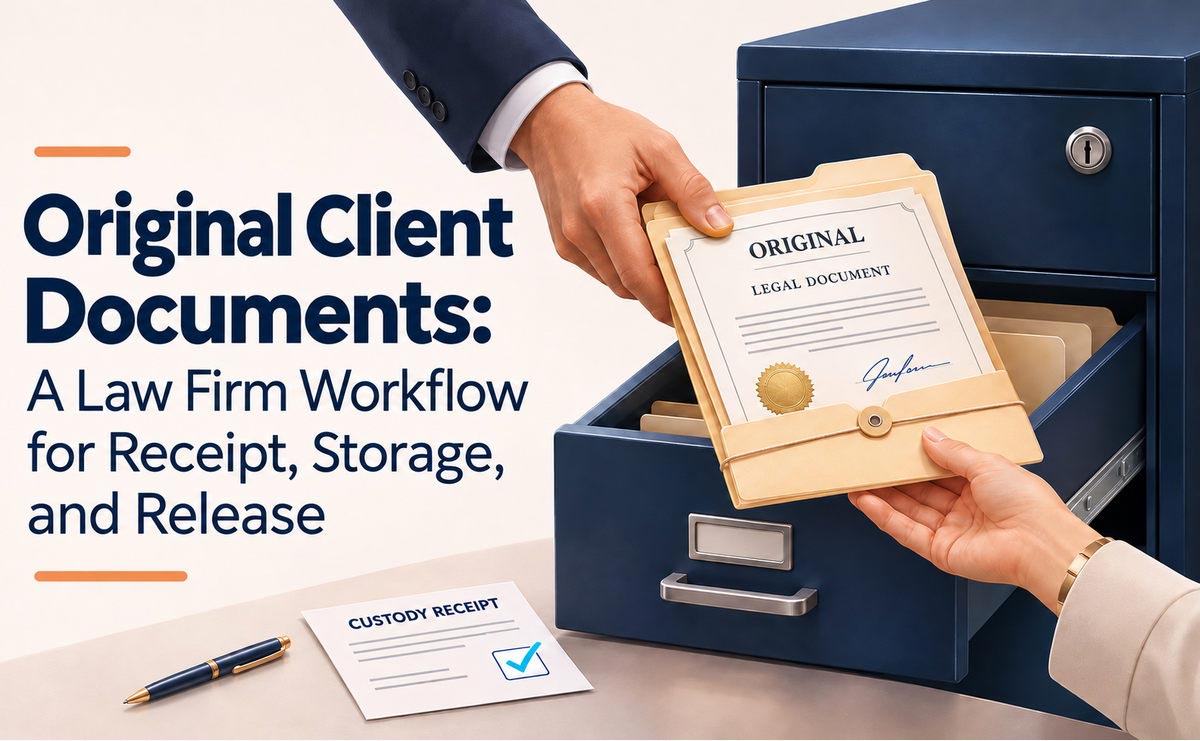
Original client documents need a custody process as soon as they arrive. Record the item, give it a secure home, track each move, and confirm who may receive it. Close the record only when the handover is complete, or another approved arrangement is documented.
This guide offers steps for handling physical originals at small and midsize firms in Canada and the United States. The steps are recommended practices, not universal legal requirements. The responsible lawyer must apply local rules, client instructions, court orders, and any terms that affect a particular document.
Set the rules for original client documents
Start by defining what the firm will accept and why. Common examples include signed agreements, original wills, certificates, deeds, and corporate records. Some arrive for a brief review. Others remain in safekeeping under an agreed arrangement.
British Columbia’s Code of Professional Conduct, section 3.5, addresses identifying, safeguarding, recording, and delivering client property. In the United States, ABA Model Rule 1.15 provides a model for safeguarding property and delivering it to those entitled to receive it. U.S. firms must check their state’s adopted rules.
Assign an owner for original client documents
Name a person who manages daily custody records and a backup who can retrieve items during an absence. Name the lawyer who decides questions about ownership, disclosure, disputed requests, and release restrictions.
Set clear limits for reception and support staff. They may log a delivery and place it in secure temporary storage. A request to destroy an original, release a will, or send property to a new recipient needs the right review.

Agree on the purpose of storage with the client. Record how to get items back, any charges, contact details, and the duties the lawyer has approved. Avoid promising indefinite storage without a plan for future moves, staff changes, or practice closure.
Check and log each delivery
Log original client documents when they enter the firm’s custody. Include deliveries by hand, post, courier, or another lawyer. Use a secure holding location when the usual records owner is away, with a task for that person to finish the entry.
Record what actually arrived
Compare original client documents with the covering letter or delivery list. Identify each item by its title, date, parties, and any useful reference number. Note visible damage, missing pages, attached certificates, or a sealed envelope that staff has not opened.
Do not describe a document as authentic simply because it appears signed. When its status is unclear, record what you can observe and ask the lawyer to classify it. Keep labels on a protective folder or sleeve rather than writing on the original itself.
Count separate signed sets when more than one arrives. Two originals of an agreement need records that let staff account for both. A single entry saying “contract received” leaves too much room for confusion later.
Give the sender a useful acknowledgment
Confirm the items received and the purpose for which the firm holds them. For example: “We received one signed agreement dated November 2, 2026, with its attached schedule, for review on matter 1042.”
Avoid adding facts the receiving staff member has not checked. A sealed package can be acknowledged as a sealed package. Tell the responsible lawyer about any difference between the expected and actual contents, especially if the document is needed for an upcoming step.
Create one custody record for each item
The record should connect original client documents to their matter, physical location, and movement history. A controlled register can serve this purpose. Give each item a stable reference so the record still makes sense after a cabinet move or matter closure.
Use the following fields as a starting point. Adapt them to the practice and avoid collecting details that serve no purpose.
| Record field | What to capture |
| Item reference | Unique ID and linked matter number |
| Description | Document title, date, identifying parties, and number of signed sets |
| Receipt | Date received, source, receiving staff member, and condition |
| Custody basis | Why the firm holds it and relevant client instructions |
| Location | Storage site, cabinet or box reference, and current holder |
| Movement | From, to, date, purpose, expected return, and actual return |
| Release | Request, authority check, approval, recipient, method, and receipt |
| Open issue | Restriction, discrepancy, next action, owner, and review date |
Keep earlier events when the location changes. An entry that only shows today’s cabinet cannot explain who took an item out last week. Correct mistakes with a dated note that preserves the earlier record.
Limit access to the register. Even a document title or a person’s connection to a matter may reveal sensitive information. Keep proof of identity and legal review notes in records with the right access limits.
Scan for working use and check the result
Create a digital working copy when it serves the matter. Use the same item reference in the scan’s name or description so staff can match it to the physical record.
The scan of original client documents should be easy to distinguish from a draft, a certified copy, or a document signed electronically. Record its source and scan date. Avoid filenames that imply the PDF is the physical original.
Check completeness before filing the scan
Compare the digital copy with the paper. Check page order, reverse sides with content, schedules, signatures, seals, and faint marks. Open the saved file to confirm that the right matter received a readable copy.
Do not remove bindings, detach exhibits, or alter a fragile document just to fit a scanner. Ask for a suitable capture method when ordinary scanning would risk damage. Preserve the source scan if staff later create an annotated working version.
RunSensible’s legal document version control guide can support the separate task of naming and managing working versions. The custody record should continue to show where the tangible item is held.
Make a separate decision about the paper
Scanning alone does not settle whether the firm may destroy the paper. The Florida Bar’s advisory Ethics Opinion 06-1 addresses exceptions to electronic-only storage, including client-owned originals, required originals, and possible harm to the client’s interests.
Send any proposed destruction of original client documents to the responsible lawyer for a separate decision. Record the basis and applicable instructions. An ordinary scan-and-shred routine should not make that decision by default.
Use secure storage with a precise location
Choose storage that suits the document’s value, condition, use, and expected storage period. Assess access, fire and water exposure, and how staff will get an item when needed. A lock does little good if staff cannot work out which box to open.
Give original client documents a location that another authorized person can follow. “Off-site” is too broad. A site, box reference, and internal item reference provide a clearer path without exposing unnecessary details on the outside of a package.
Keep temporary storage under control
Use a designated locked holding area for items awaiting review, scanning, or final filing. Add an owner and next action to the record. Review the holding area so items do not stay there unseen.
Keep original client documents away from general scanning trays, recycling, and paper queued for destruction. If an item must stay on a lawyer’s desk for work, log the holder and arrange secure storage when it is unattended.

Game-Changing Legal Document Automation Software for Lawyers
For an outside storage firm, review access, transport, how to get items back, how to report problems, and how to end the service. Test how the firm would find an urgent item if the main records contact were away.
Log movement and expected returns
Record movement before original client documents leave their usual location. Include internal loans, court attendance, expert review, courier transfers, and temporary return to a client. Name the person taking custody and the purpose.
An expected return date creates a follow-up task. It is an internal control, not a change to a court deadline or another legal duty. If the plan changes, update the task and keep the reason in the history.
Confirm both ends of the move
The person receiving the item should confirm what they received. On return, compare it with the item description and record its condition, date, and storage location. Follow up on a missing schedule or different page count before closing the loan.
If a court, registry, or institution will keep original client documents, record that as its disposition. Save the submission evidence and any acknowledgment. Do not leave a return task running when the approved plan was permanent delivery.
For office moves, reconcile the inventory as boxes leave and again as they arrive. Resolve differences while the people who handled the move can still help. Keep a link between old and new location references.
Check the request and authority before release
A request for original client documents starts a review; it does not complete one. Confirm the requested item, who is asking, whom they represent, and where they want it sent. Then check the instructions and restrictions that apply.
Separate identity from authority
Knowing who a person is does not establish their right to receive property. A relative, beneficiary, company employee, or new adviser may still need authority for the specific request.
The lawyer should decide what evidence is appropriate. This may involve client instructions, an appointment document, corporate authority, or a court order. Record what was checked and the decision without placing sensitive evidence in a broadly shared register.
Verify a changed delivery address through a reliable contact route already held by the firm. Avoid relying only on contact details supplied in the same unexpected request. Match the level of checks to the item and the risk.
Treat requests for wills with care
The Law Society of Alberta’s guidance on requests for wills explains that confidentiality continues after death. It addresses the requester’s identity, relationship, and authority, including requests through another lawyer. These are Alberta-specific examples; apply the rules governing the actual file.
Reception should refer these requests without confirming confidential details or promising release. The lawyer can assess the document, requester, supporting evidence, and any disagreement before giving staff a clear instruction.
Escalate competing claims
If two people seek the same item, or a restriction is unclear, flag the issue for prompt legal review. Record any urgency, assign an owner, and set the next review date. Seek appropriate advice or directions where needed.
An unpaid invoice should also go to the lawyer rather than trigger an automatic hold. Whether the firm has a valid basis to retain property depends on the applicable rules and circumstances.
Prepare, deliver, and confirm the handover
Once release is approved, match the item against the approval. Check the title, date, attachments, number of originals, recipient, address, and delivery method. For an irreplaceable item, consider a second-person check.
Use a specific release record
The handover record for original client documents should identify what is leaving, who approved it, who receives it, and how it travels. Keep the release instructions and proof of authority with the matter.
For collection of original client documents in person, check who is collecting them against the approved plan. Get a signed receipt that lists each item. A courier or assistant collecting for the client should fit that arrangement too. A signature from an unexpected person does not resolve an authority question.
For delivery, use packaging and a service suited to the item. Keep dispatch details and tracking records. Where possible, confirm that the intended recipient received the complete contents; a delivery scan may show only that a package reached an address.
Keep the task open until the outcome is known
Use a clear pending status while you await delivery or a signed receipt. Assign someone to investigate a delay, failed delivery, or returned package. Do not mark the item “received by client” when the evidence only shows dispatch.
After completion, record the recipient, date, and evidence of receipt. Keep the history under the firm’s approved policy. If someone else takes custody under a new plan, state where the item is going and on what terms.

Resolve gaps without hiding the history
When original client documents cannot be located, alert the responsible lawyer and records owner promptly. Check movement entries, recent scans, temporary storage, courier records, and the last confirmed holder.
Keep a factual search log for original client documents. State what is known, what remains uncertain, and when each location was checked. Do not replace a missing item with a copy and change the register to suggest the original was returned.
The lawyer should assess any urgent client impact, reporting duties, insurer notice, preservation steps, and available remedy. Do not promise that a replacement will have the same effect as the missing item.
Keep custody visible after matter closure
A closed matter may still have original client documents in storage. Carry the custody record into a continuing register with an owner and contact plan. The paper should remain traceable after staff stops using the active matter list.
Use the firm’s client file retention guidance for the separate review of storage periods and disposal policies. Check the governing rules before acting on any retention period. A matter’s age alone should not decide what happens to property still held for someone else.
Best practices for a repeatable process
Start with a small sample of original client documents and test the process from receipt through retrieval. Ask the backup custodian to locate each item from the record alone. Any missing step becomes a clear improvement task.
Set a review cycle based on the volume and risk of the practice. Review overdue returns, pending deliveries, items without precise locations, and unresolved release requests. At set times, match stored items to the register. Also check that each listed item is where the record says it is.
Keep proof of changes and completed follow-up. Train new staff with a real example after removing all private details. During leave or staff changes, transfer custody responsibilities and outstanding tasks explicitly.
Connect the records with the work
RunSensible brings matter records, documents, notes, and tasks into its practice management platform. Its matter management tools can keep the digital copy and related instructions connected to the matter. Its task management tools support assigned work, due dates, and reminders.
Use those connections to support review and follow-up for original client documents. For example, link a scan and release instruction to the matter, then assign a task to confirm receipt. Keep the approved physical custody register available to the staff who need it.
These are uses of connected records and tasks. They do not establish a dedicated physical inventory system or decide a recipient’s legal authority. Test the firm’s chosen setup with actual retrieval, movement, and release scenarios before relying on it.
Common mistakes to avoid
- Logging only the scan. Record the physical item and its location as well.
- Using vague descriptions. Identify the date, attachments, and number of originals.
- Leaving movements informal. Record a colleague’s loan as carefully as an external transfer.
- Treating identity as permission. Check authority for the particular item and request.
- Closing the task at dispatch. Track the handover to its confirmed outcome.
- Archiving unresolved custody. Keep stored items visible after the matter closes.

Frequently asked questions
Can we destroy an original after scanning it?
A scan does not authorize destruction of original client documents. The lawyer must review ownership, legal requirements, evidentiary needs, client instructions, and any other restrictions. Keep that decision separate from the routine scanning task.
What should we do if a client sends originals we did not request?
Record and secure the delivery, then ask the lawyer to review why the firm holds it. Confirm the arrangement with the client and decide whether to return the items or retain them for an approved purpose.
Can a client’s relative collect a document?
Check the authority for that collection. A family relationship alone does not resolve the question. Confirm the approved item, recipient, and collection arrangement before staff makes the handover.
Is a courier tracking number enough proof of release?
It helps show dispatch and delivery progress. Pair it with the item list, approval, verified recipient details, and appropriate acknowledgment. Investigate a delivery record that does not match the planned handover.
What happens if the matter is closed but the firm still holds property?
Keep a continuing custody record and assign responsibility for it. Record the storage basis, location, contact plan, and any unresolved issue. Do not let closing the matter remove the item from future reviews.
Can software replace the physical custody register?
The firm can use a suitable digital register if it supports its approved process. Test access controls, item identification, movement history, retrieval, and release evidence. A folder of scans alone does not provide that record.
Conclusion
Original client documents should remain traceable through every change of holder and location. Give each item a clear record, protect it in storage, and check authority before release. Confirm the handover and preserve its history.
Begin with one group of originals already in the office. Match each item to a record and location, assign open questions, and test retrieval with the backup custodian. Connect the scans and follow-up tasks to the matter so the next request has a clear owner and a reliable answer.
Publishing notes
Matter management connects scans, notes, client details, and instructions with the relevant matter. Document management supports storage and organization of the digital working copies. Task management supports assigned release reviews, expected-return dates, and receipt follow-up. The firm must design and verify its physical custody process; these feature descriptions do not establish a dedicated inventory or barcode module.
Resources
- Law Society of British Columbia Code of Professional Conduct section 3.5 — Client property, identification, safekeeping, records, and delivery. British Columbia rules.
- American Bar Association Model Rule 1.15 — Model duties for safeguarding property and delivery to those entitled to receive it. State-adopted rules govern U.S. practice.
- The Florida Bar Ethics Opinion 06-1 — Electronic storage and exceptions for retaining originals. Advisory opinion dated April 10, 2006; not binding.
- Law Society of Alberta Ethical Considerations Regarding Requests for Wills — Confidentiality and authority when wills are requested by others. Guidance last updated October 2022; Alberta-specific.
Disclaimer: The content provided on this blog is for informational purposes only and does not constitute legal, financial, or professional advice.